


160mm - ISO 90º bend
160mm - ISO 90º bend
SKU : 90000467
Overview
The Airflow Airflex ISO 160mm 90° Insulated Duct Bend provides a lightweight, durable solution for changing the direction of MVHR and mechanical ventilation ductwork. Featuring pre-insulated EPE construction, a smooth internal surface and an included male connector, it helps minimise heat loss and reduce condensation risk. 160mm diameter – 90° bend – male connector included. End of Line – Limited Stock Available.Out of Stock
Couldn't load pickup availability


Description
Airflow Airflex ISO 160mm 90° Insulated Duct Bend with Male Connector
The Airflow Airflex ISO 160mm 90° Insulated Duct Bend (90000467) is a durable, pre-insulated ducting component designed for mechanical ventilation systems, including Mechanical Ventilation with Heat Recovery (MVHR).
Designed to provide a 90-degree change in ductwork direction, this insulated elbow allows ventilation systems to navigate corners and obstacles while maintaining thermal insulation and efficient airflow.
Manufactured from high-quality, vapour-tight and anti-static expanded polyethylene (EPE), the Airflex ISO bend helps minimise heat loss and reduce the risk of condensation forming within ventilation ductwork.
Ideal for installations in unheated spaces such as lofts, roof voids and service areas, the bend is supplied with an internal plastic male connector for straightforward installation with compatible Airflow Airflex ISO components.
Key Features
-
160mm Diameter: Compatible with Airflow Airflex ISO 160mm insulated ducting systems.
-
90° Bend: Allows ductwork to change direction around corners and obstacles.
-
Pre-Insulated Construction: Helps minimise heat loss and reduce condensation risk.
-
Male Connector Included: Supplied with an internal plastic connector for easy installation.
-
Lightweight & Durable: Manufactured from tough, anti-static expanded polyethylene (EPE).
-
Smooth Internal Surface: Helps minimise airflow resistance and supports efficient ventilation.
-
Sound-Absorbing Properties: Helps reduce noise transmission through the ducting system.
-
Flame Retardant: Classified as B1 according to Airflow's product specifications.
-
Versatile Application: Suitable for MVHR and mechanical ventilation installations.
Technical Specifications
| Specification | Details |
|---|---|
| Manufacturer | Airflow Developments |
| Product Range | Airflex ISO |
| Product Type | Insulated 90° Duct Bend |
| Product Code / SKU | 90000467 |
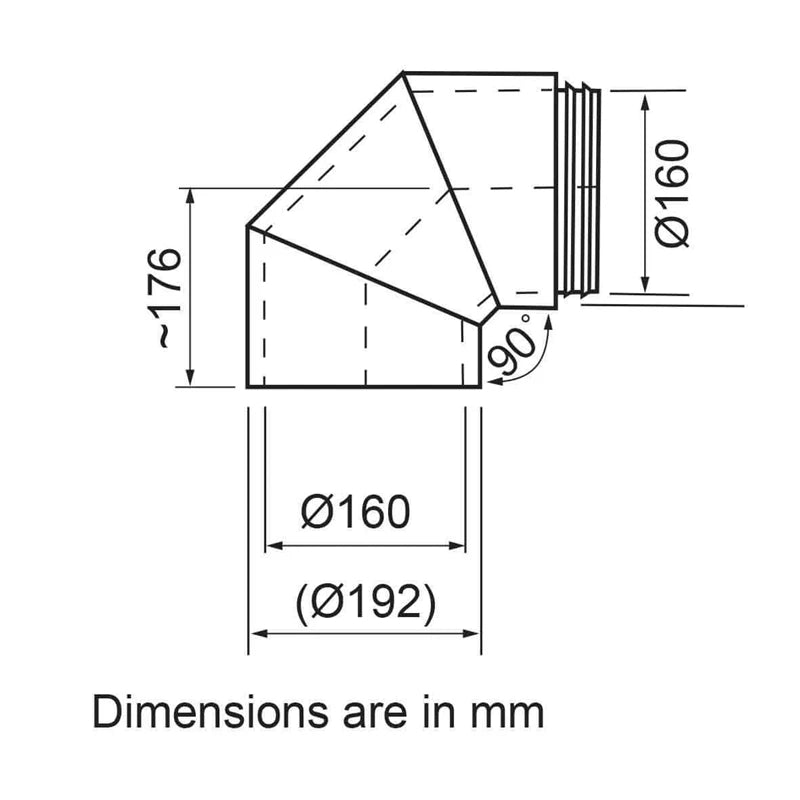
| Nominal Diameter | 160mm |
| External Diameter | 192mm |
| Bend Angle | 90° |
| Dimension C | 272mm |
| Insulation Thickness | 15mm |
| Material | Expanded Polyethylene (EPE) |
| Material Density | 60g/dm³ |
| Thermal Conductivity | 0.042 W/mK |
| Temperature Range | -25°C to +80°C |
| Fire Classification | B1 |
| Connection | Internal Plastic Male Connector |
| Application | MVHR & Mechanical Ventilation Systems |
Important Information
This product is supplied as one 160mm 90° insulated duct bend with an internal plastic male connector.
Designed for use with compatible Airflow Airflex ISO insulated ducting components. Straight ducting lengths and additional fittings are sold separately.
Please check the diameter and connection requirements of your ventilation system before purchasing.
End of Line – While Stocks Last
Limited remaining stock available. Once sold out, this product will not be restocked.
Frequently Asked Questions
-
What’s the difference between thermal ducting and insulated standard ductwork?
-
Does thermal ducting come pre-insulated?
-
Do I need thermal ducting if my loft is already insulated?